What Microduck is
Last updated
Microduck is a 25 cm, 800 g bipedal robot made by Pollen Robotics, a company Hugging Face acquired in 2025.
The part that matters is not the hardware. Every move it makes comes from a reinforcement-learning policy, not a recorded animation. Walking, standing up after a fall, crouching to pick something off the floor, roller skating — each is trained in simulation, exported as an .onnx file, and run on the robot.
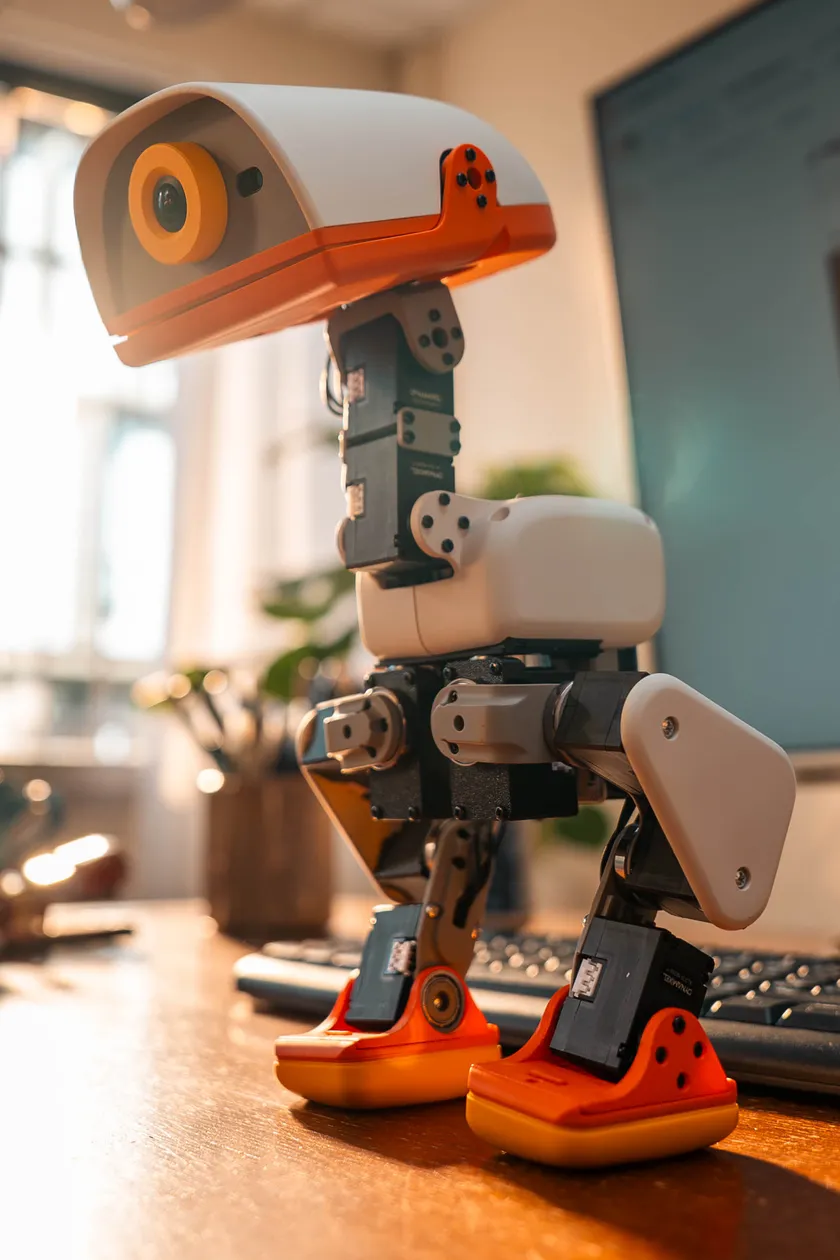
How it differs from a robot toy
One: the motion is learned, not choreographed. A conventional servo robot replays recorded keyframes and falls over the moment reality departs from the recording. Microduck’s policies are trained with PPO in MuJoCo, so what they learned is how to stay balanced rather than how to strike a pose. Push it over and it stands itself back up; walk it over uneven ground and it adapts.
Two: the software stack is open, under Apache-2.0.
- pollen-robotics/microduck — the robot’s own software
- pollen-robotics/microduck_rl — the reinforcement learning environments
Note the scope. The open-source statement covers the software stack. The mechanical and electronic design files are not included.
Three: you can train your own policy and run it. No release to cut, no firmware to flash. Point the config file at your own .onnx, restart robotd, and it is live. This is what makes it a platform for physical AI rather than a consumer toy.
Specification
| Height | 25 cm |
| Weight | 800 g |
| Motors | 15 servos (Dynamixel XL330) |
| Board | Rockchip RK3566 |
| Sensors | Camera, depth sensor, two IMUs |
| Control loop | 50 Hz onboard policy inference |
| Software licence | Apache-2.0 |
That 50 Hz is worth remembering: policies are trained at 50 Hz too, and both ends matching is one of the reasons a simulated gait survives the move to hardware.
Seven moves in the box
The robot ships already able to do these — you do not have to learn to train first:
- Walk — driven straight from the sticks
- Sit and stand
- Kick — one button per leg
- Grab — beak to the floor
- Roller skate — fit the wheels, hold D-pad up to switch modes
- Get back up — knock it over and it stands itself up
- Plus quacking and beak movement
It also has a voice of its own: the sound bank is generated from the board’s serial number, so two ducks in a room can be told apart by ear. Several can sing together in four parts (Chinese).
What is in the box, and the price
The robot, a battery, a USB-C cable, and a game controller. The pad is included — you do not need to buy one.
$399 for the base robot (introductory price, before tax and shipping), preorders opened 27 August 2026, four colourways. Optional packs: charger $39, dev $119, accessories $39.
Who it suits
A good fit for anyone who wants to do reinforcement learning sim2real work with real hardware, for robotics students and teachers, and for developers who want a platform they can actually change.
Possibly not for someone who wants a desk ornament. It does work out of the box, but most of the value is in training and modifying it. It is also not a cleaning, companion, or household robot — it is an experimental platform.
Where to go next
- You have the hardware → First run
- You do not, and want to look first → the online simulator
- You want the commands → robotctl reference (Chinese)